The invisible gap that's costing you
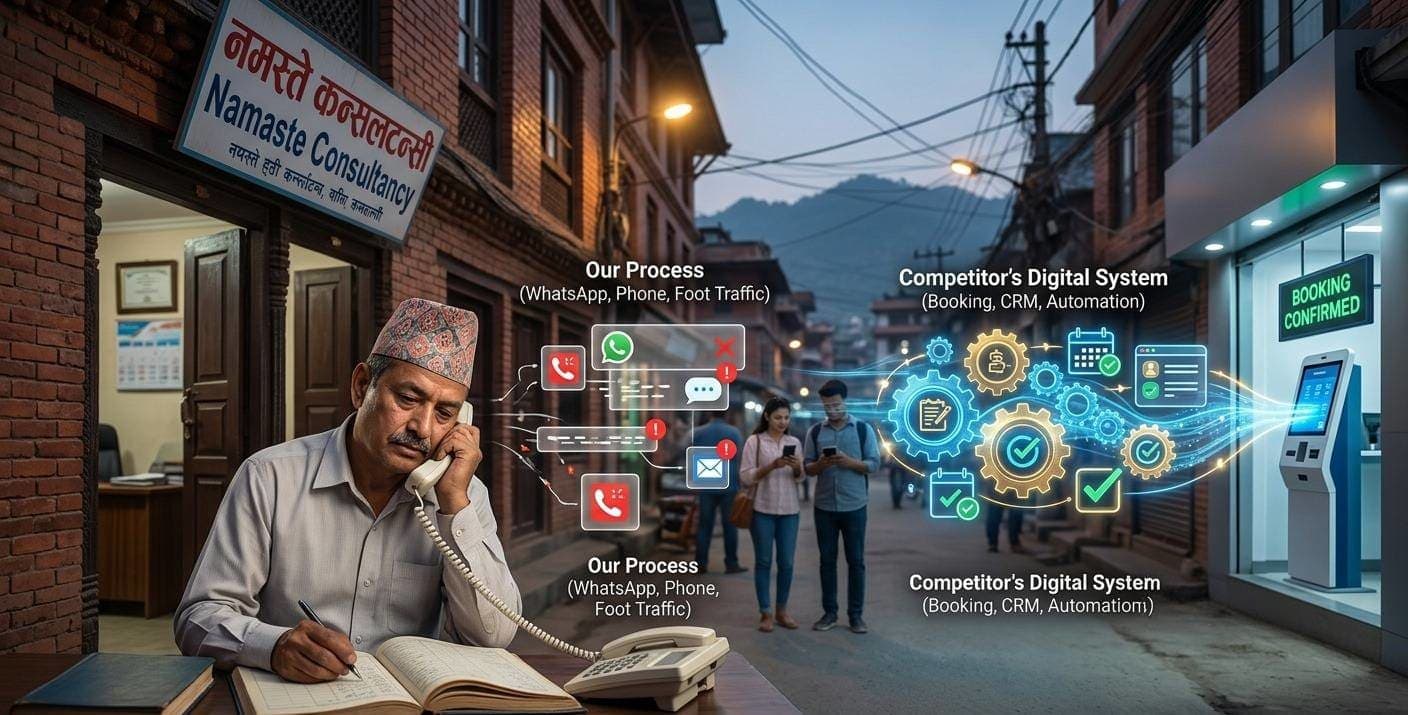
Your competitor just got a new customer that should have been yours. They didn't win on price. They didn't win on quality. They won because their booking system worked at 10pm on a Sunday when your phone was off.
This is happening across Nepal right now — in gyms, beauty parlors, consultancies, restaurants, and retail stores — and most business owners don't see it until it's too late.
When we started Leaflet, we worked closely with a Kathmandu gym that was doing everything right. Good trainers. Reasonable prices. A loyal core of members. But their bookings were done over the phone and WhatsApp. New clients had to call during working hours, wait for a response, and confirm manually.
Down the road, a newer gym had launched with a simple online booking system. Clients could book a slot at midnight, pay in advance, and get an automated reminder. The older gym wasn't losing on the product. They were losing on the process.
Three patterns we see again and again
Pattern 1: The WhatsApp bottleneck
For many Nepali businesses, WhatsApp is doing the work of a CRM, a booking system, a payment processor, and a customer service desk simultaneously. It works — until it doesn't. Messages get missed. Follow-ups fall through. There's no record of who asked what or when. The business owner becomes the single point of failure for every customer interaction.
Pattern 2: The walk-in dependency
Businesses that rely entirely on foot traffic are vulnerable in a way that's easy to underestimate. A new competitor opens nearby. A road gets dug up. A season changes. Walk-ins drop and there's no digital channel to compensate. The businesses that weathered these disruptions best were the ones that had built an online presence — not just a Facebook page, but a system that could capture and convert interest regardless of physical footfall.
Pattern 3: The manual paperwork trap
We worked with a consultancy that was spending 15+ hours a week on administrative work that could have been automated: scheduling, document collection, follow-up emails, invoice generation. That's nearly two working days a week spent on process rather than client work. After building them a lightweight custom operations system, they cut that admin time by half. The same number of staff could now handle significantly more clients.
What "going digital" actually means
There's a misconception that digital transformation means building an app or redesigning a website. Sometimes it does. But often the highest-ROI digital investment is more targeted: a system that automates one specific thing that's currently costing you time, money, or customers.
Before spending money on a full website overhaul, ask yourself:
- Where are we losing customers because our process is inconvenient?
- What task does someone on our team do manually every week that a system could handle?
- What information do we wish we had about our customers that we currently don't track?
The answers tell you where to invest.
The compounding advantage
Here's what most businesses miss: digital systems compound. A booking system that saves you 5 hours a week this year saves you 250 hours over the year. A CRM that improves your client follow-up rate by 20% doesn't just win you one extra client — it wins you one extra client every month, and each of those clients refers others.
“The Nepali businesses pulling ahead right now aren't the ones with the biggest budgets. They're the ones that started building these systems 12 months ago while their competitors waited.”
Where to start
If you're reading this and recognising your business in any of the patterns above, you don't need to fix everything at once. Start with the single biggest friction point in your customer journey — the moment where a motivated prospect is most likely to give up or go elsewhere. Fix that one thing well. Measure the result. Then build from there.
That's the approach we take with every client at Leaflet — not a grand digital transformation plan, but a practical sequence of improvements that each pay for themselves.
Frequently asked questions
Yes, especially if you're experiencing any of the three patterns above. The return isn't about size, it's about how much the current friction is costing you in missed bookings, wasted admin time, or lost follow-ups. Many of our smallest clients see the fastest ROI.