What custom software is actually for
Custom software gets sold as the answer to almost every business problem. Slow operations? Build a system. Losing leads? Build a CRM. Scaling too slowly? Build a platform.
Sometimes that's exactly right. Often it isn't — and the businesses that invest in custom software before they're ready end up with an expensive tool they're not equipped to use, maintain, or grow with.
We've built custom software for over 50 clients across Nepal, Australia, and Europe. We've also told prospective clients — more than a few times — that they weren't ready for it yet. This piece is an honest look at how to tell the difference.
The signs you're ready
You're duct-taping tools together and it's getting expensive
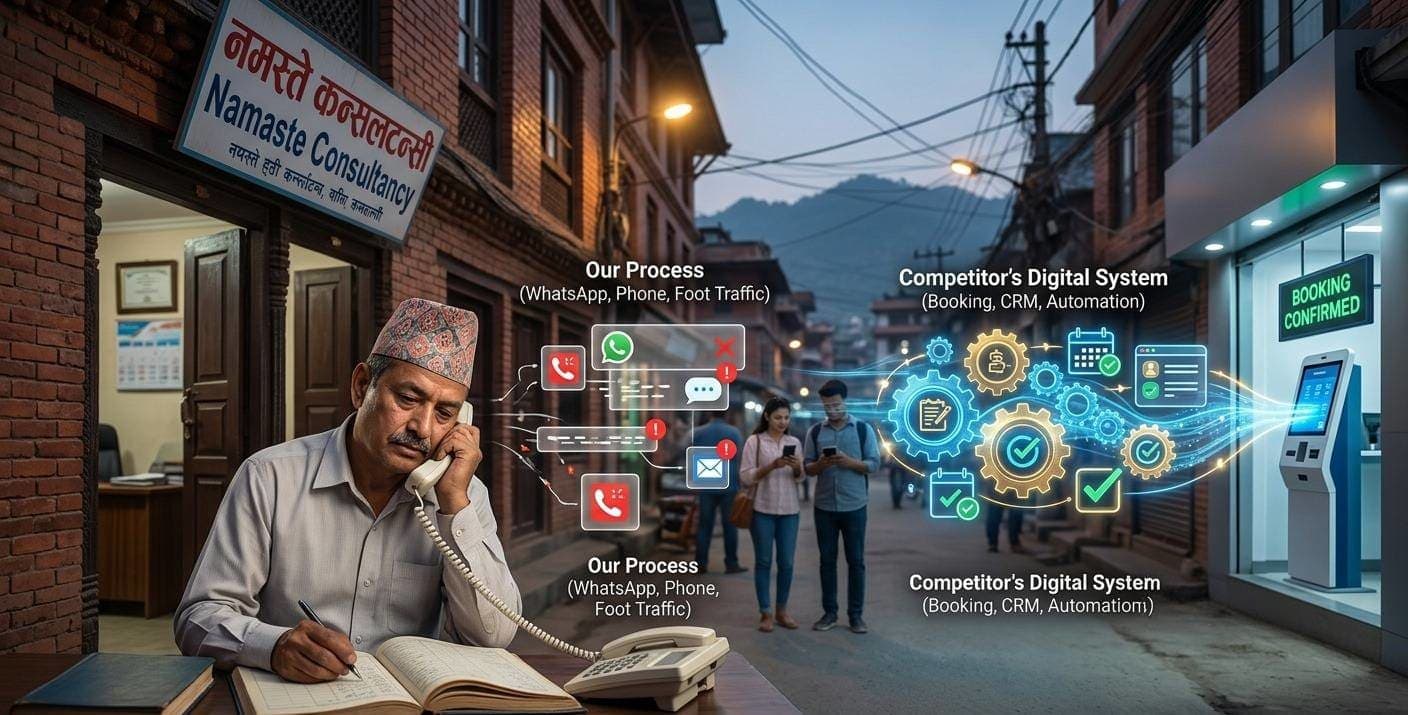
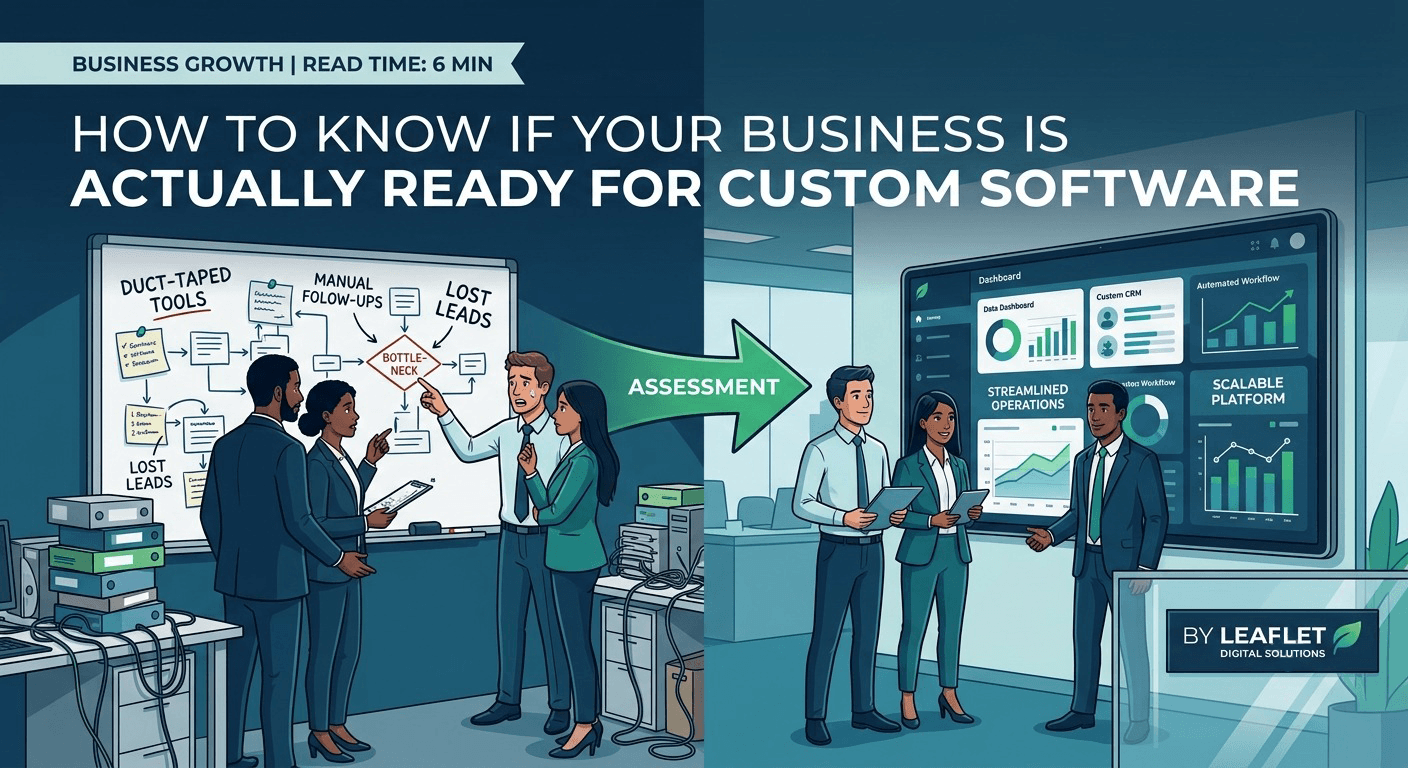
Many growing businesses reach a point where they're running on a patchwork of tools — a spreadsheet feeding into a form feeding into a WhatsApp group feeding into someone's email inbox. Each tool does its part, but the handoffs are manual, error-prone, and increasingly time-consuming. When the time your team spends managing the system exceeds what a proper build would cost over 12 months, you're ready.
Your process is genuinely unique
If your business has a workflow that isn't well-served by any existing product — a specific combination of features, integrations, or data structures that off-the-shelf software doesn't handle — custom development makes sense. If your workflow is broadly standard — booking, invoicing, CRM, project management — explore whether an existing tool serves you first. There's no virtue in building what you can buy.
You're losing customers or revenue because of a process gap
This is the clearest signal. If you can trace lost revenue to a specific operational weakness, and that weakness is a process problem not a product problem, custom software is a direct investment with a calculable return.
“One of our clients was losing potential clients at the initial enquiry stage because follow-up was manual and inconsistent. After we built them a lightweight intake and scheduling system, their conversion rate on enquiries increased significantly within the first quarter.”
Your team has someone who will own the system
This is the most underrated readiness criterion. Custom software requires a person inside your business who understands it well enough to train new team members, troubleshoot basic issues, and request changes. Without that internal ownership, the best-built system quietly falls into disuse. Before commissioning a build, identify who that person is.
The signs you're not ready yet
You're building to solve a problem you haven't fully understood yet
The most expensive custom software projects are the ones built around an assumed problem. A business that hasn't done the work of mapping their current process — step by step, person by person — doesn't know what they actually need. We always spend the first phase of any engagement on discovery: mapping current workflows, identifying where the real friction is, and sometimes discovering that the originally described problem isn't the root cause.
You have fewer than 20 transactions, clients, or units per month
At very low volume, almost any manual process or off-the-shelf tool will serve you adequately. Custom software is an investment that pays off with scale. Focus on growth first — build the system when the problem is real and measurable, not in anticipation of a scale you haven't reached.
Your team isn't using the tools you already have
If your team isn't consistently using the project management tool, CRM, or communication platform you already have, the problem isn't the software — it's adoption. A custom build won't fix that. It will give you a more expensive version of the same problem.
You need something live in two weeks
Good custom software takes time: scoping, design, build, testing, handover. A project compressed into an unrealistic timeline will either be poorly built, poorly tested, or both. If you have an immediate need, explore off-the-shelf options first and plan a custom build properly once the immediate pressure is resolved.
A framework for the decision
Before investing in custom software, answer these four questions honestly:
- 1What specific problem will this solve, and what does it cost us today (in time, revenue, or customers) not to have it?
- 2What off-the-shelf tools have we evaluated, and why don't they work for us?
- 3Who inside our team will own this system after it's built?
- 4Do we have the budget to build it properly — including a realistic timeline, testing, and a maintenance arrangement after launch?
If you can answer all four clearly and confidently, you're ready for a custom build. If any of them are vague, start there before you start the project.
“The best software development partners will tell you when you're not ready. If a company's first response to every business problem is a proposal for custom development, they're optimising for their revenue, not your outcome.”
We've had first conversations that ended with us recommending a client use a better-configured version of a tool they already had, or sign up for a specific SaaS product rather than build from scratch. Those conversations don't generate immediate projects for us. But they build the kind of trust that leads to the right projects later.
Frequently asked questions
Add up the hours your team spends on manual handoffs, workarounds, and error corrections per week, then multiply by your average hourly cost. If that number annualised approaches a reasonable build cost, you're ready. We can help you run this calculation in a discovery call.